
The contracted order book and the strength of certain strategic businesses, such as Nuclear, help preserve the Company’s medium and long-term fundamentals, while short-term priorities remain focused on logistics normalisation, reducing working capital requirements and converting working capital into cash
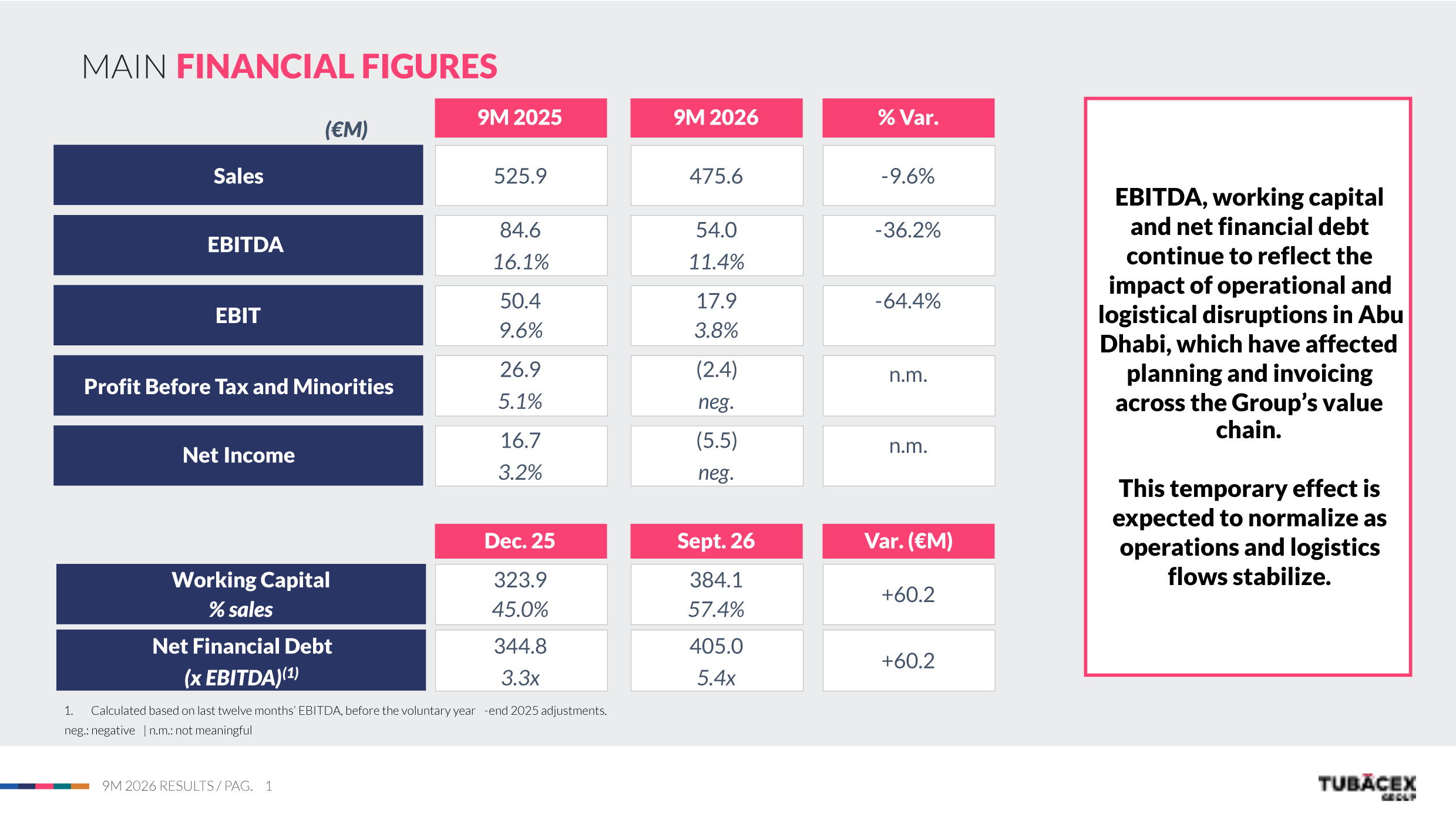
- Sales: €475.6 million, down 9.6% compared with the first nine months of 2025, still reflecting the impact of lower order intake during 2025 and a complex environment marked by tariff uncertainty and geopolitical tensions in the Middle East.
- EBITDA: €54.0 million, with an EBITDA margin of 11.4%, affected by higher energy costs. Excluding the operating cost overruns arising from the conflict in the Middle East and assuming a normalised level of activity, the EBITDA margin would have been within the strategic target range.
- Working capital and debt: working capital stood at €384.1 million and net financial debt at €405.0 million. The increase is directly linked to the ADNOC supply chain: €145.5 million working capital relates to balances associated with this supply chain, whose monetisation is secured by the multi-year US$1,000 million product supply contract under a take-or-pay arrangement. If the extraordinary effect of the €64.9 million in short-term receivables from the ADNOC joint venture were isolated (compared with €15.3 million at year-end 2025), NFD would have stood at approximately €340 million, broadly in line with year-end 2025.
- Liquidity and investment: the company maintains a liquidity position of €162.9 million and an equity-to-total-assets ratio of 33%. Structural net financial debt stands at €20.9 million and cumulative CAPEX amounts to €35 million, maintaining financial discipline and a selective allocation of resources.
- Order book: €1,162.4 million at the end of September, slightly above the June level and showing a first sign of stabilisation after several quarters of decline. The pipeline includes advanced opportunities in SURF, Nuclear and Aerospace & Defence.
- Outlook: the fourth quarter will continue to be affected by a challenging environment. Looking ahead to 2027, the already contracted order book, the progressive normalisation of operations and logistics, and the conversion of projects currently under negotiation and expected awards should provide a solid basis for recovering activity, reducing working capital and strengthening cash generation.
Bilbao, 30 October 2026. Tubacex closed the first nine months of 2026 with sales of €475.6 million, down 9.6% compared with the same period of the previous year, and EBITDA of €54.0 million, equivalent to an EBITDA margin of 11.4%.
Performance continues to reflect the impact of the lower order intake recorded during 2025, against a backdrop marked by tariff and regulatory policies, the war in Ukraine and instability in the Middle East, factors that continue to delay customers’ investment decisions and constrain the pace of recovery in activity. Since March, operational and logistics disruptions affecting our facilities in Abu Dhabi have impacted planning, supply flows and invoicing throughout the Group’s value chain, resulting in higher working capital requirements.
However, current pressure is concentrated primarily on volumes, costs and execution schedules, rather than on any structural deterioration in demand. Against this backdrop, the stability of the order book, which has already increased slightly compared with June, together with the performance of premium and long-cycle businesses, continues to support Tubacex’s strong market positioning.
Profitability affected by lower volumes and higher costs
EBITDA for the first nine months amounted to €54.0 million, compared with €84.6 million in the same period of 2025, representing a decline of 36.2%. The EBITDA margin stood at 11.4%, compared with 16.1% in the previous year. Profitability was mainly affected by lower activity levels, which limited fixed-cost absorption, together with higher logistics and energy costs associated with supplies to Abu Dhabi.
Excluding the operating cost overruns arising from the conflict in the Middle East and assuming a normalised level of activity, the EBITDA margin would have been within the strategic target range. Efficiency improvement measures, operational discipline, the selection of strategic projects and the growing weight of higher-value-added solutions have nevertheless contributed to maintaining a double-digit EBITDA margin in this environment. EBIT amounted to €17.9 million, while attributable net profit stood at -€5.5 million.
Market performance and multisector positioning
The sales mix for the first nine months continues to reflect a strong contribution from the Group’s strategic businesses. E&P, which remains the Group’s main business pillar, accounts for 55.1% of sales, with 36.0% corresponding to E&P Gas and 19.1% to E&P Oil. Process Industries contributes 23.3%, followed by Other Markets at 12.4%, Power Generation at 5.1%, and Aerospace & Defence at 4.1%. Although the latter two still account for a limited share of sales, they provide significant technological content and exposure to markets with attractive medium-term growth prospects.
By geography, Asia & Middle East remains the Group’s main destination region, accounting for 46.0% of total sales, while Europe and the Americas each represent 26.0% and Africa 2.0%.
Commercial activity continues to show uneven performance across markets, with stronger momentum in premium, technology-driven and long-cycle businesses than in those more exposed to pricing and short-term investment decisions. Industrial diversification and proximity to key global customers remain important levers in reducing the cyclicality of the business.
In OCTG, sales remain robust and continue to grow, supported by Abu Dhabi and the continuity of supply to ADNOC under the existing contract. The company is also seeing signs of increased activity and momentum in other Middle Eastern markets. In Brazil, Petrobras has recognised Tubacex as Best OCTG Supplier 2026 for the second consecutive year, further strengthening a long-standing strategic relationship.
In SURF, the order book for umbilical tubes stands at record levels and commercial enquiries have increased compared with 2025. During the year, welding and spooling capacity has been expanded, while further capacity additions are being assessed to support the expected development of demand.
In Drilling, order intake has improved, driven primarily by Dubai and Norway, although the recovery remains uneven across markets.
Aerospace & Defence continues to show positive commercial momentum and, by the end of September, had already exceeded its commercial target for the full year, supported particularly by aerospace and space applications. During the period, further progress was also made in new qualifications, aerospace distribution capabilities and the development of titanium tubes.
In Power Generation, the company continues to strengthen its positioning in Nuclear. Tubacex has secured its first orders associated with SMR projects in North America and continues to carry out maintenance activities at power plants in the United States and the Czech Republic, in addition to supplying further material for Hinkley Point. It also has advanced-stage opportunities with EDF and Westinghouse, with further awards expected before year-end.
By contrast, Process Industries continues to experience a slower recovery cycle. Refining and Petrochemicals remain affected by delays in investment decisions and by competitive pressure from Asia on lower-value-added products. In Fertilizers, however, interest in premium grades is increasing, particularly for urea applications. Meanwhile, activity in Low Carbon continues to progress in CCUS, hydrogen, geothermal and other applications related to the energy transition.
Solid order book and first signs of stabilisation
The order book stood at €1,162.4 million at the end of September, slightly above the level recorded in June and showing a first sign of stabilisation after several quarters of decline.
E&P Oil & Gas accounts for 82.1% of the order book, at €954.7 million, reflecting the weight of the Group’s strategic contracts. Power Generation contributes €67.3 million and Aerospace & Defence €52.5 million, reinforcing the Group’s presence in strategic segments and high-value-added applications, while Process Industries contributes €52.1 million and Other Markets €35.8 million. The order book provides strong visibility over future activity, while a growing number of opportunities in Subsea, Nuclear and Aerospace & Defence are approaching the award stage. The main uncertainty continues to relate to the timing of the conversion of these opportunities, rather than to the existence of structural demand in these markets, which remains visible to the company.
Focus on working capital normalisation and cash generation
Working capital reached €384.1 million at the end of September, compared with €323.9 million at December 2025, while net financial debt stood at €405.0 million. Both figures increased by €60.2 million compared at year-end 2025, bringing the NFD/EBITDA ratio to 5.4x.
The increase in both figures is directly linked to the ADNOC supply chain. Within working capital, €145.5 million relates to balances associated with this supply chain and recorded across different Group entities, of which €64.9 million corresponds to short-term receivables from the Abu Dhabi joint venture (vs. €15.3 million at year-end 2025). These amounts are linked to the execution of the multi-year supply contract with ADNOC, worth US$1,000 million and structured on a take-or-pay basis, which contractually secures their monetisation and provides visibility over invoicing and cash flows expected over the coming months. For illustrative purposes only, if the effect of the €64.9 million in short-term receivables were isolated, net financial debt would have stood at approximately €340 million, broadly in line with the level recorded at year-end 2025. This reference does not represent an adjustment to reported NFD but rather helps to quantify the extraordinary impact of an item whose recovery is contractually backed by ADNOC.
These balances also reflect the effort made by Tubacex to guarantee continuity of supply to a strategic customer in an exceptional logistics environment and provide visibility over production, invoicing and cash flows for the coming months.
Accordingly, the increase in working capital and debt is fundamentally the result of a temporary timing mismatch between production, transportation, delivery, invoicing and collection relating to activity backed by a long-term contract. The progressive stabilisation of operations and logistics flows should enable these balances to be converted into deliveries, invoicing and cash, contributing to a reduction in working capital and net financial debt over the coming quarters.
Tubacex maintains a liquidity position of €162.9 million, an equity-to-total-assets ratio of 33% and structural net financial debt of €20.9 million.
Outlook: normalisation and execution as priorities towards 2027
The fourth quarter of this year will continue to unfold against a challenging commercial, regulatory and geopolitical backdrop, which continues to affect investment decisions and award schedules. The safeguard measures adopted by the European Union since July could contribute to a gradual recovery in activity in Europe after two years of weakness, although their impact will depend on their effective translation into new orders.
Looking ahead to 2027, Tubacex enters a year expected to be shaped primarily by operational normalisation and the execution of an already contracted order book, supported by long-term strategic customers and significant exposure to OCTG, SURF, Nuclear and Aerospace & Defence. Improved logistics flows should also allow the company to make further progress in monetising accumulated working capital, strengthening cash generation and reducing debt.